The Model 3 Method
The Model 3 Method differs in important ways from traditional prevention-focused curricula. Rather than building the program around a comprehensive knowledge set that students must master to “complete the course,” it focuses instead on guiding students through a learning path that maximizes the likelihood they will make real-world choices that lead to “favorable outcomes.” In other words, the primary student outcome we are seeking is to increase the odds that students will Make Better Choices in real-world situations.
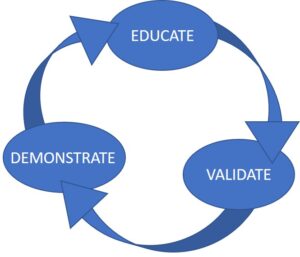
To achieve this outcome, we take the position that “education” alone is not enough. Instead, the Model 3 Method takes a three-pronged approach – Educate, Validate, and Demonstrate.
- EDUCATE – While education (knowledge) is essential to increasing the odds that students will make better choices, we also believe that education alone is not sufficient.
- VALIDATE – Validating information for oneself transforms the learner from being a knowledge receiver (passive) to a being a knowledge seeker (active).
- DEMONSTRATE – Testing one’s knowledge through interaction with others builds confidence and self-reliance.
Our approach to EDUCATING is guided by three principles:
- Provide objective facts and information; encourage inquisitiveness
- Structure and package discrete learning experiences to provide regular “aha” insights, where learning is crystalized (e.g., using effective storytelling principles)
- Organize learning around 3 Must Knows, to ensure successful cognitive integration of material.[1] With respect to opioid awareness, the 3 Must Knows are 1) “Opioids are both legal and illegal,” 2) “One pill can kill,” and 3) Good Samaritans are protected”
In addition to educating, we teach students to VALIDATE:
- How to identify reliable, independent sources of information; social media does NOT count as a primary source
- Building and learning to trust one’s own ability to discern what is true and what is not true
- Incorporating this skill set into one’s “personal brand”
Third, we encourage students to DEMONSTRATE their learning through:
- Peer to peer teaching and learning
- Interaction with others to test and strengthen understanding
- Explicitly linking the 3 Must Knows to Making Better Choices
- “Opioids are both legal and illegal” –> There are many routes to addiction
- “One pill can kill” –> Refuse to accept a pill from someone
- “Good Samaritan are protected” –> Intervention is possible in a crisis situation
[1] Our pedagogical approach is informed by the work of Blake Richards and Paul Frankland, as described in “Why Students Forget – And What You Can Do About It” [https://www.edutopia.org/article/why-students-forget-and-what-you-can-do-about-it]